01 / Subvision Robotics
ZIMA subsea rover
Organisms growing on ship hulls increase drag and fuel use. We’re developing ZIMA, which we believe is the world’s first robot built to prevent this buildup with UV-C light. The rover combines magnetic swerve drive with close-range treatment.
- My role
- Founder, CEO & technical lead
- Period
- Mar 2024 – present
- Team
- 12 people
- Stage
- Prototype development
Prototype footage & simulation
Chassis and drive design
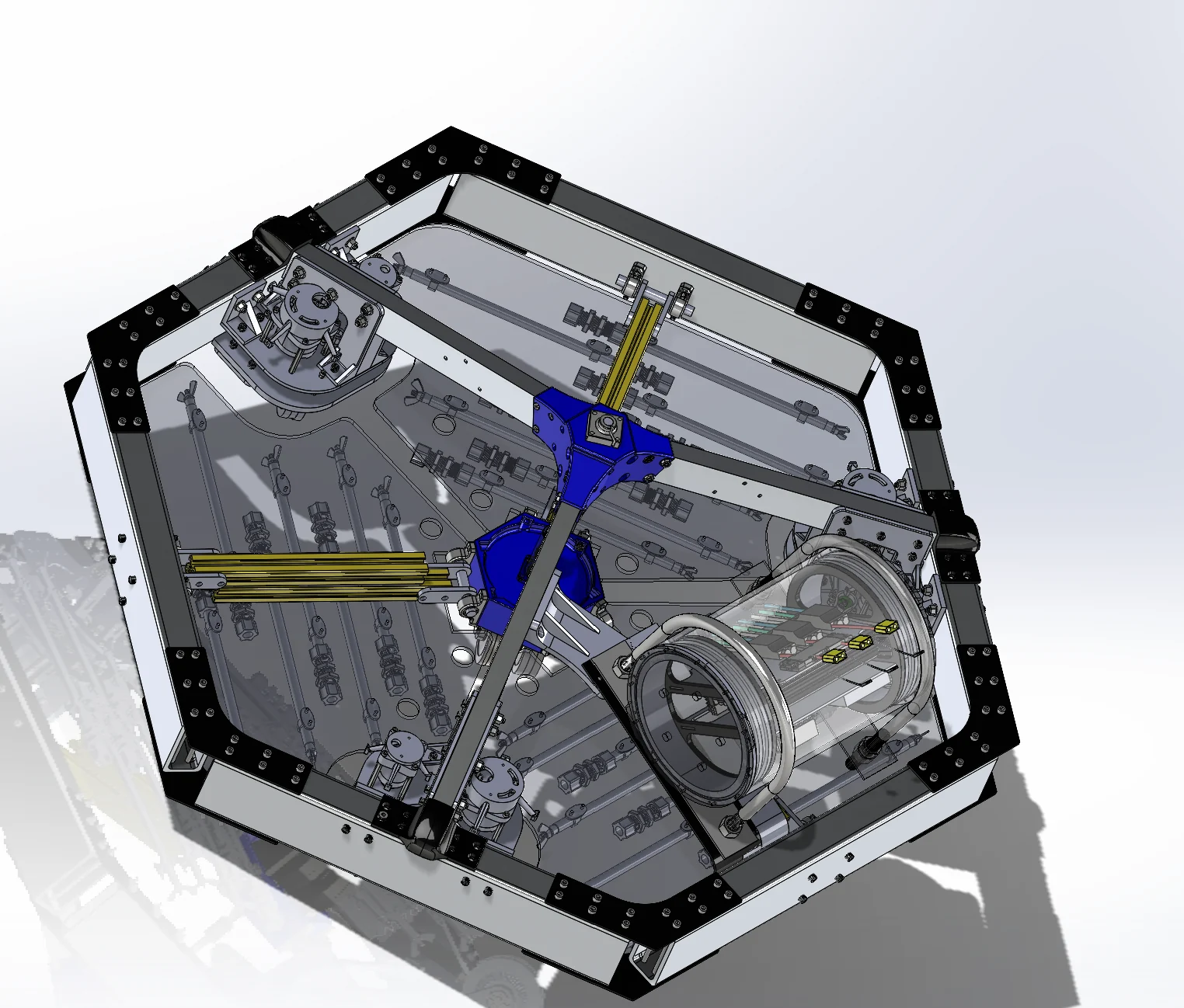
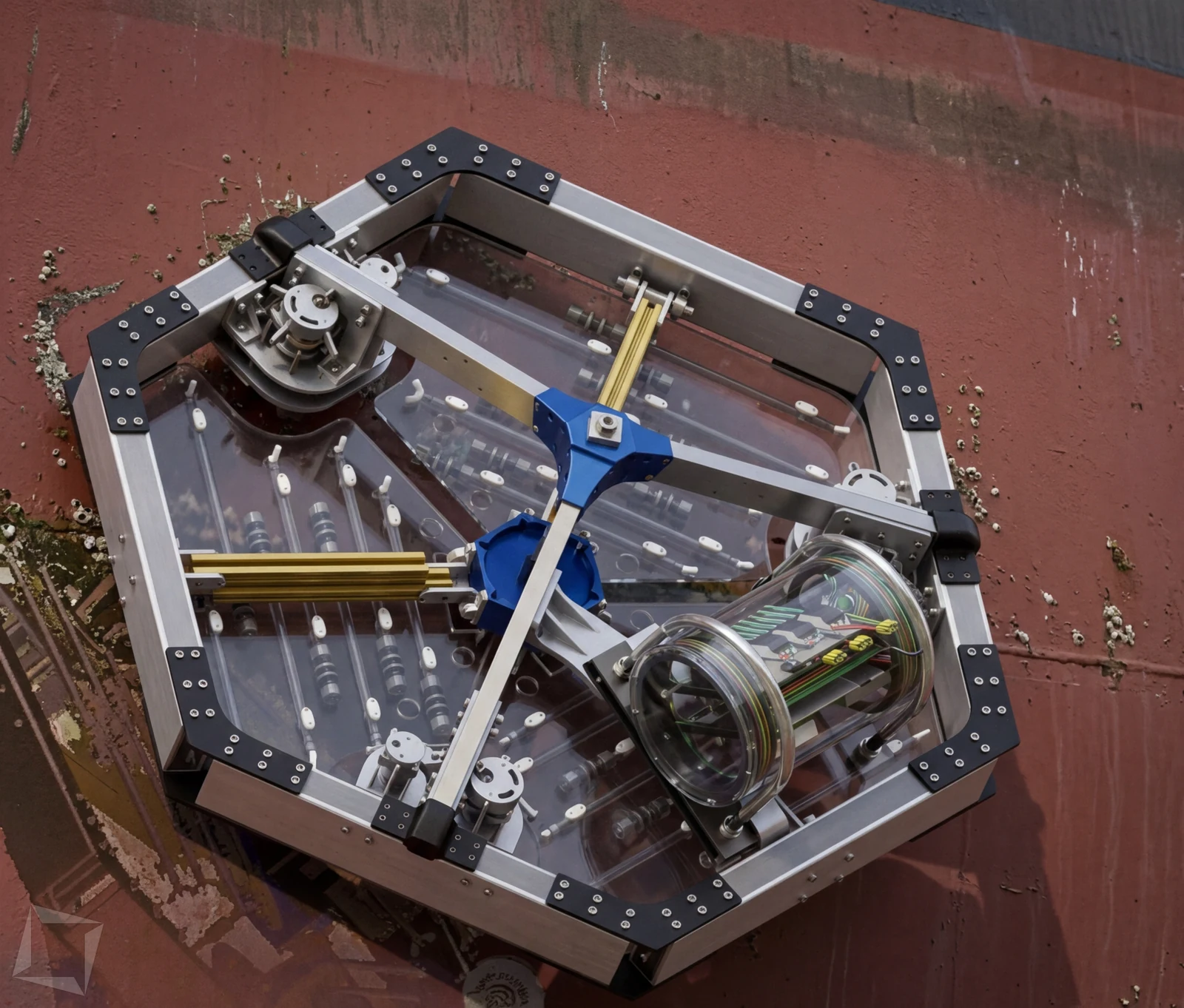
I designed the chassis and drive layout and worked on the subsea swerve gearboxes. Three independently steered drive modules sit around a hexagonal frame, with a compliant central support wheel.
The robot is tethered and supervised. Magnetic wheels provide attachment; the UV-C hardware is intended to treat the hull before heavy growth develops.
Electrical integration
I led ZIMA’s system architecture and electrical integration, coordinating the electrical team’s detailed power design with the mechanical, controls, and communications interfaces.
- Tether
- 125 m
- Conversion constraint
- 600 W
- Power distribution
- 24 V / 12 V / 5 V
Power architecture
The full-scale prototype combines three magnetic swerve-drive modules, six ESCs, UV-C treatment hardware, embedded compute, and Ethernet-over-tether communications. I coordinated the interfaces around a high-voltage DC tether and cascaded Vicor DCM3714 and Bel VFK600 converters.
| Rail | Loads |
|---|---|
| 24 V | Propulsion: three T500 drive motors |
| 12 V | Three T200 steering motors and approximately 24 ft of UV-C lighting |
| 5 V | Compute and sensing electronics |
Integration & bring-up
My system-level work covered branch power budgets, DC fusing, current monitoring, connector and insulation limits, grounding, and staged startup of capacitive motor-controller loads. I coordinated the motors and ESCs with Jetson Nano compute and Fathom-X communications, with ACS37800 selected for current sensing.
Packaging requirements included an 8-inch subsea enclosure, an estimated 100 W internal heat load, and an operating-temperature target below 50°C.
Commissioning
I led fault isolation for converter restart cycling, examining long-tether impedance, source current limiting, ESC capacitance, and converter protection behavior. Final power commissioning, protection coordination, and representative-hull testing remain in progress.
Controls & autonomy
I evaluated sensor options and control methods for ZIMA, helping set the team’s direction for motion control and autonomy.
I lead this work across the team, connecting sensor selection and control methods to the rover’s software, actuation, and integration plans.
What has been tested.
We have built and tested prototype hardware in the water. The footage above shows that hardware; the coverage sequence is a simulation.
Hardware calibration, operation on representative hulls, and UV-C treatment performance still need validation.
I lead the 12-person team across mechanical, electrical, sensing, and testing work, and coordinate subsystem integration and test planning.
Exhibition & team context
Presenting ZIMA
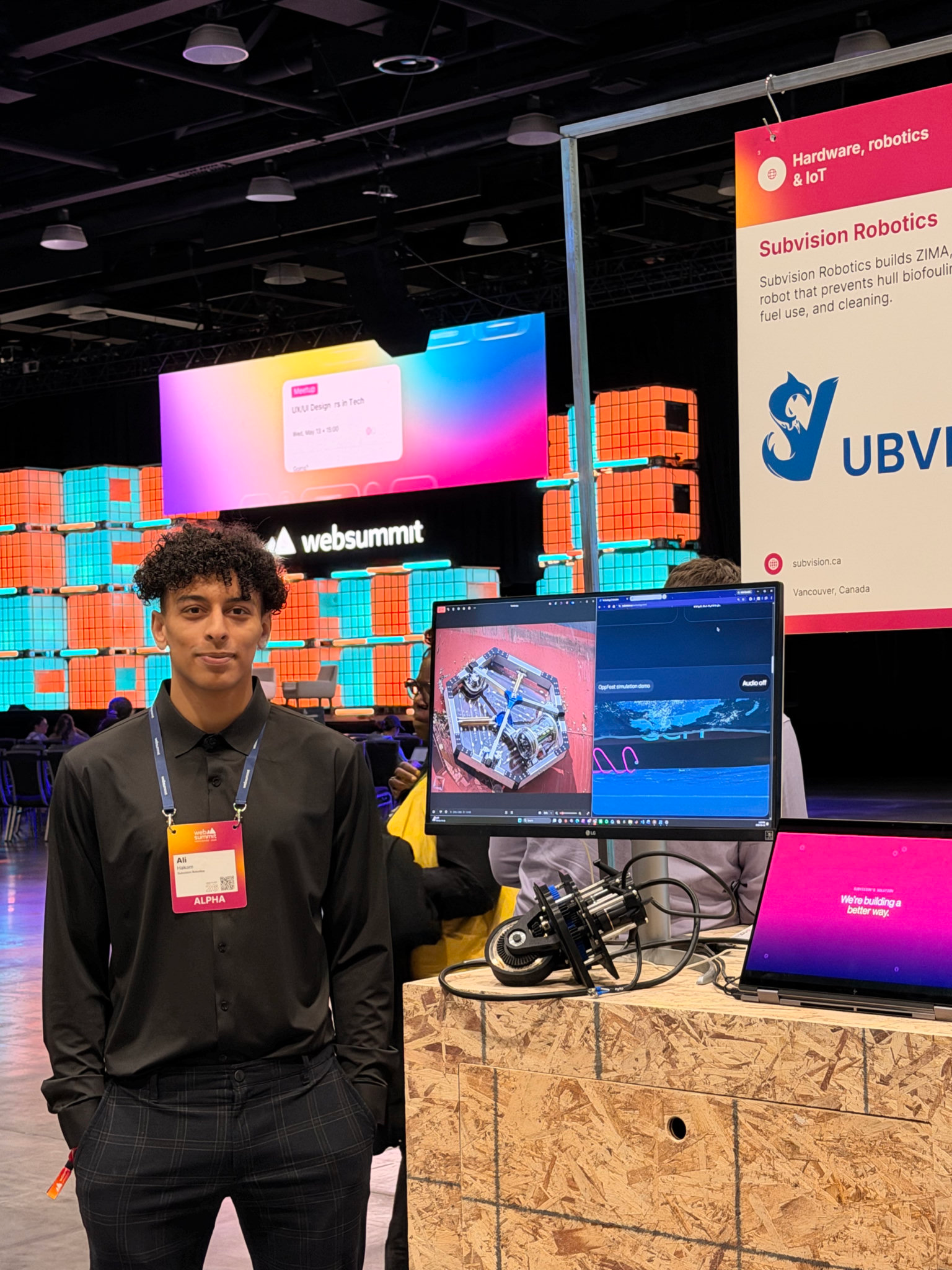
At Web Summit, I presented ZIMA and demonstrated our prototype. I pitched to investors and walked investors and industry partners through the technology, our progress, and our development plans.
Team awards and entrepreneurship support are collected in the homepage recognition section.
View recognition & support ↗